
What Is the Softmax Function? How It Works in Neural Networks Explained
A simple guide to softmax and how it converts outputs into probabilities
In Deep Learning, activation functions are important because they introduce non-linearity into neural networks allowing them to learn complex patterns. Softmax Activation Function transforms a vector of numbers into a probability distribution, where each value represents the likelihood of a particular class. It is especially important for multi-class classification problems.
- Each output value lies between 0 and 1.
- The sum of all output values equals 1.
This property makes Softmax ideal for scenarios where each output neuron represents the probability of a distinct class.
Softmax Function
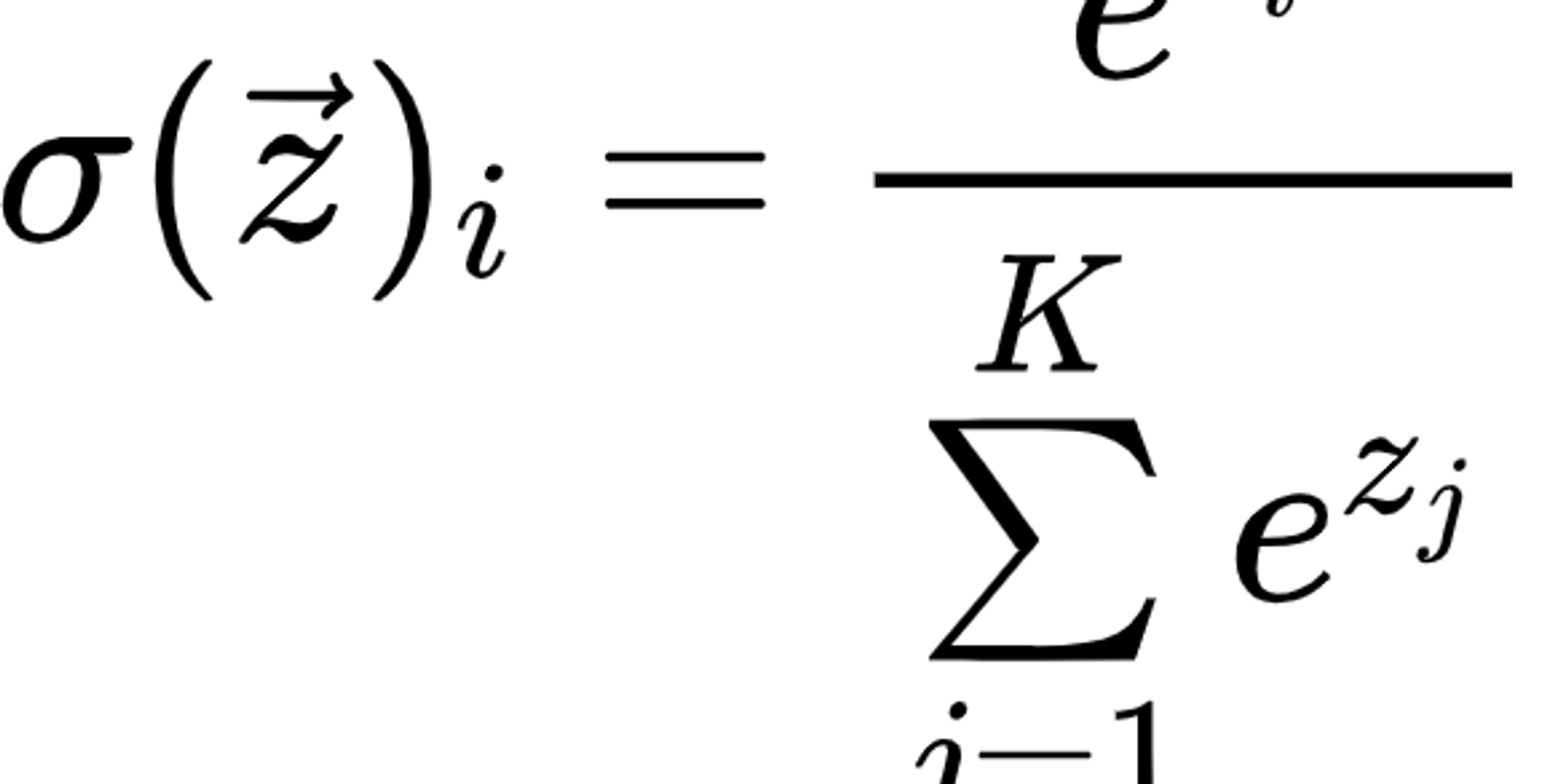
For a given vector, z = [z_1, z_2, \dots, z_n]the Softmax function is defined as:
where:
- e^{z_j}: Exponentiation of the input value.
- \sum_{j=1}^{n} e^{z_j}: Sum of all exponentiated values to normalize outputs.
Each output \sigma(z_i) represents the probability of class i.
Key Characteristics
- Normalization: Converts logits into a probability distribution where the sum equals 1.
- Exponentiation: Amplifies larger values making the model’s confidence more pronounced.
- Differentiable: Enables gradient-based optimization during backpropagation.
- Probabilistic Interpretation: Makes output easier to interpret as class likelihoods.
How Softmax Activation Function Works
Softmax converts a vector of raw scores into a probability distribution.
- Input Scores: Take the raw output vector from the model. These values can be any real numbers.
- Exponentiate: Apply e^x to make every value positive and amplify differences.
- Sum of exponentials: Compute the normalising constant Z = \sum e^{x'}
- Normalize: Divide each exponent by Z to get probabilities p_i = \frac{e^{x'_i}}{Z}.
- Output (Probabilities): Final probability vector can be used with argmax to pick the predicted class.
Step-By-Step Implementation
Step 1: Import Necessary Libraries
- import Numpy for numerical operations
- Tensorflow and Keras to build and train the neural network.
- Use Matplotlib for visualizing training accuracy and loss.
Step 2: Load and Prepare the Dataset
- Load the Iris dataset multi-class classification dataset.
- Extract features and labels from the dataset.
- Convert labels to one-hot encoded format for softmax based training.
- Split the data into training and testing sets for evaluation.
Step 3: Neural Network Model
- Sequential to create a simple feedforward neural
- The hidden layer uses ReLU activition to learn non linear patterns.
- The output layer uses Softmax activation to product class probabilities.
Step 4: Compile the Model
- Define Adam optimizer for efficient gradient updates.
- categorical_crossentropy as the loss function for multi-class problems.
- Compiling prepares the model for training.
Step 5: Train the Model
- Train the model using the training dataset.
- Run for 100 epochs with a small batch size for better learning.
- Use validation_split=0.2 to monitor overfitting during training.
- The history object stores loss and accuracy data for visualization
Step 6: Predict and Display Probabilities
- Use the trained model to predict class probabilities via Softmax.
- Determine the predicted class with the highest probability.
- Display both predicted probabilities and the corresponding class name.
Output:

Why Use Softmax in the Last Layer
The Softmax Activation function is typically used in the final layer of a classification neural network because:
- It transforms the model raw output into interpretable probabilities.
- It ensures the outputs are mutually exclusive suitable for problems where each sample belongs to exactly one class.
- It works seamlessly with the Cross Entropy Loss Function which measures the difference between predicted and actual probabilities.
Applications
- Neural Networks: Used in the output layer of models like CNNs or MLPs for multi-class classification.
- Attention Mechanisms: Assigns attention weights to different tokens or words, normalizing them to sum to 1.
- Reinforcement Learning: Converts Q values or action values into probabilities for stochastic action selection.
- Model Ensembles: Combines multiple model predictions into a single probabilistic output.
Challenges
- Overconfidence: Tends to produce extremely confident predictions even for uncertain inputs.
- Sensitivity to Outliers: Small variations in logits can cause large shifts in probability outputs.
- Softmax Bottleneck: Limited ability to model complex relationships between output classes.
- Poor Calibration: Predicted probabilities often do not align with true likelihoods.
- Gradient Saturation: Can cause vanishing gradients when one class probability dominates others.
Difference Between Sigmoid and Softmax Activation Function
Sigmoid and Softmax are activation functions used in classification tasks.
- Sigmoid gives a single probability for binary output.
- Softmax distributes probabilities across multiple classes in multi-class problems.
| Parameters | Sigmoid Activation Function | Softmax Activation Function |
|---|---|---|
| Definition | Maps any real valued input to a value between 0 and 1 | Converts a vector of real number into a probability distribution |
| Purpose | Used for binary classification problems | Used for multiclass classification problems |
| Number of Outputs | one independent probability per neuron | Multiple interdependent probabilities for all classes |
| Use case | Predicting two classed | Predicting multiple classes |
| Output | Represents confidence for one class | Represents probabilities for all classes |
Applications
- Neural Networks: Used in the output layer of models like CNNs or MLPs for multi-class classification.
- Attention Mechanisms: Assigns attention weights to different tokens or words, normalizing them to sum to 1.
- Reinforcement Learning: Converts Q values or action values into probabilities for stochastic action selection.
- Model Ensembles: Combines multiple model predictions into a single probabilistic output.
Challenges
- Overconfidence: Tends to produce extremely confident predictions even for uncertain inputs.
- Sensitivity to Outliers: Small variations in logits can cause large shifts in probability outputs.
- Softmax Bottleneck: Limited ability to model complex relationships between output classes.
- Poor Calibration: Predicted probabilities often do not align with true likelihoods.
- Gradient Saturation: Can cause vanishing gradients when one class probability dominates others.
First Lesson
You are at the beginning of this curriculum.
Latest Tutorial
More chapters coming soon to this topic.

Leave a Reply
Share your insights, questions, or solutions with the developer community.
Discussion
0No comments yet
Be the first to share your thoughts, question a concept, or provide additional tips!