
Top 10 Most Popular Programming Languages in 2026 (With Comparison & Code Examples)
An empirical analysis of GitHub Octoverse data, TIOBE rankings, enterprise memory-safety mandates, and production code benchmarks.
1. Executive Summary & Industry Shift
In 2026, programming language adoption is governed by three macro-architectural forces: the production scaling of Generative AI, enterprise-wide memory safety mandates (enforced by CISA and NIST standards), and the industry-wide transition to static type systems to safeguard against AI code hallucinations. Synthesizing real-world telemetry from the GitHub Octoverse, TIOBE Index, Stack Overflow Developer Survey, and global hiring data, TypeScript has taken the #1 position for active contributors on GitHub (2.64M active engineers), while Python commands the AI orchestration ecosystem, and Rust has entered the TIOBE Top 10 as the undisputed benchmark for non-garbage-collected, memory-safe systems engineering.
2. Technical & Labor Market Comparison Matrix (2026 Telemetry)
| Programming Language | Primary Focus Domains | Concurrency & Runtime Model | Memory Management | Global Hiring Demand Share | US Median Salary (2026) |
|---|---|---|---|---|---|
| Python | AI Orchestration, Data Engineering | asyncio / Free-threaded (PEP 703) | Tracing GC + Reference Counting | ~20% of job requisitions | $125,000 – $140,000 |
| JavaScript | Universal Web Client, Serverless | Single-threaded Event Loop | V8 Generational GC | Combined JS/TS: ~31% | $117,000 – $155,000 |
| TypeScript | Enterprise Web, Full-Stack SaaS | Event Loop + Static Type Erasure | V8 Generational GC | #1 Contributor Base (GitHub) | $130,000 – $160,000 |
| Java | Core Banking, Distributed Systems | Virtual Threads (Project Loom) | Generational ZGC / Shenandoah | ~15% of job requisitions | $120,000 – $150,000 |
| C# | Enterprise Cloud, Unity 3D, XR | Async/Await & Thread Pool | .NET CLR Non-blocking GC | ~12% of job requisitions | $115,000 – $145,000 |
| C / C++ | Hardware Kernels, HFT, Game Engines | Native OS Threads / POSIX | RAII / Manual Pointer Alloc | High (Domain Specialist) | $130,000 – $165,000 |
| Go (Golang) | Cloud Infrastructure, Kubernetes, APIs | M:N Green Threads (Goroutines) | Concurrent Tri-color Mark-Sweep | High (+19% Salary Premium) | $150,000 – $180,000 |
| Rust | Systems, Embedded, WASM, Security | Native OS Threads / tokio (Async) | Compile-Time Borrow Checker (No GC) | Rapidly Rising (+24% Premium) | $145,000 – $175,000 |
| Kotlin | Android Native, Cross-Platform (KMP) | Structured Concurrency (Coroutines) | JVM Managed GC | Specialized Mobile (~2%) | $118,000 – $140,000 |
| Swift | Apple Ecosystem (iOS, macOS, visionOS) | Swift 6 Actor Model / Task Groups | Automatic Reference Counting (ARC) | Ecosystem Bound | $125,000 – $155,000 |
3. Top 10 Languages: Architectural Deep Dives & Production Code
1. Python: The AI & ML Orchestration Gateway
Python serves as the high-level control plane for modern deep learning. With the mainstreaming of PEP 703 (Free-threaded Python) to eliminate the Global Interpreter Lock (GIL) and runtime tensor offloading to C++/CUDA, Python bridges developer velocity with hardware execution:
2. JavaScript: The Universal Client-Side Foundation
JavaScript powers 98.8% of modern client applications. While developers author complex applications in TypeScript, JavaScript remains the non-negotiable runtime target for V8, SpiderMonkey, and JavaScriptCore across browsers and edge worker runtimes:
3. TypeScript: The Enterprise Standard Against AI Code Drift
TypeScript has officially become the #1 language on GitHub by active monthly contributors (2.64M). With over 90% of LLM-generated code errors tracing back to parameter mismatches or missing object fields, TypeScript's strict structural type checker serves as an automated firewall against hallucinated pull requests:
4. Java: Enterprise Workhorse with Modern Concurrency
Driven by Project Loom (Virtual Threads) in recent LTS releases, Java has transformed how enterprise financial networks manage high-throughput I/O. By abstracting threads from OS-level primitives to lightweight JVM-managed tasks, millions of concurrent connections can be sustained without reactive boilerplate:
5. C#: High-Performance Cloud & Interactive Media
C# captured TIOBE’s "Programming Language of the Year" via continuous performance optimizations in the cross-platform .NET runtime, including Native AOT (Ahead-of-Time compilation) and allocation-free Span<T> memory patterns. Beyond cloud backends, it remains the standard for gaming and immersive spatial computing via the Unity engine:
6. C / C++: Bare-Metal Performance & AI Compute Kernels
C and C++ remain irreplaceable at the lowest tier of computing infrastructure. In the era of LLMs, low-level inference libraries (e.g., llama.cpp, vLLM, TensorRT) rely on C++20/C++23 Concepts and RAII to manipulate GPU memory directly with sub-millisecond execution guarantees:
7. Go (Golang): The Cloud-Native Infrastructure Backbone
Kubernetes, Docker, Prometheus, and Terraform are all written in Go. Go's pragmatic design—compiling down to static, dependency-free binaries paired with green-thread Goroutines—makes it the standard for building cloud services:
8. Rust: Compile-Time Memory Safety without Garbage Collection
Rust's presence in the TIOBE Top 10 reflects an ongoing global mandate to eliminate memory corruption bugs (buffer overflows, use-after-free) without sacrificing performance. Its strict ownership model, affine type system, and fearless concurrency abstractions have made it the modern standard for systems software:
9. Kotlin: Modern Native Android & Multiplatform (KMP)
Kotlin remains Google's preferred language for Android, supported by language-level null safety and Structured Concurrency via Coroutines. With Kotlin Multiplatform (KMP) reaching enterprise stability, teams increasingly write business logic, networking, and validation rules once in Kotlin and deploy natively to both iOS and Android:
10. Swift: Native Apple Platforms & Swift 6 Compile-Time Concurrency
Swift is the definitive development language across iOS, macOS, watchOS, and visionOS. With the widespread adoption of Swift 6, strict concurrency checks are enabled by default—using the Actor model and Sendable types to prevent data races at compile time:
4. Architectural Analysis: Why Legacy Web Stacks (PHP & Ruby) Declined
The retirement of PHP and Ruby from the top tier reflects a permanent architectural consolidation:
- Unified Full-Stack TypeScript: Frameworks like Next.js and Remix eliminate the mental overhead of maintaining dual models. Frontend components, API routes, and database schemas share a unified TypeScript type definition end-to-end.
- Containerization & Cold-Start Latency: In serverless and containerized environments, compiled Go binaries start in single-digit milliseconds with minimal memory footprints, outperforming interpreted PHP/Ruby runtimes under autoscaling workloads.
- AI Pipeline Integration: Early-stage startups prefer Python or TypeScript, which connect directly to AI model APIs, vector stores, and tensor libraries without custom wrappers.
5. Strategic Developer Roadmap for 2026
- Enterprise Web & SaaS: Master TypeScript deeply. Focus on type-level programming (conditional types, mapped types) to establish compile-time contracts for distributed systems.
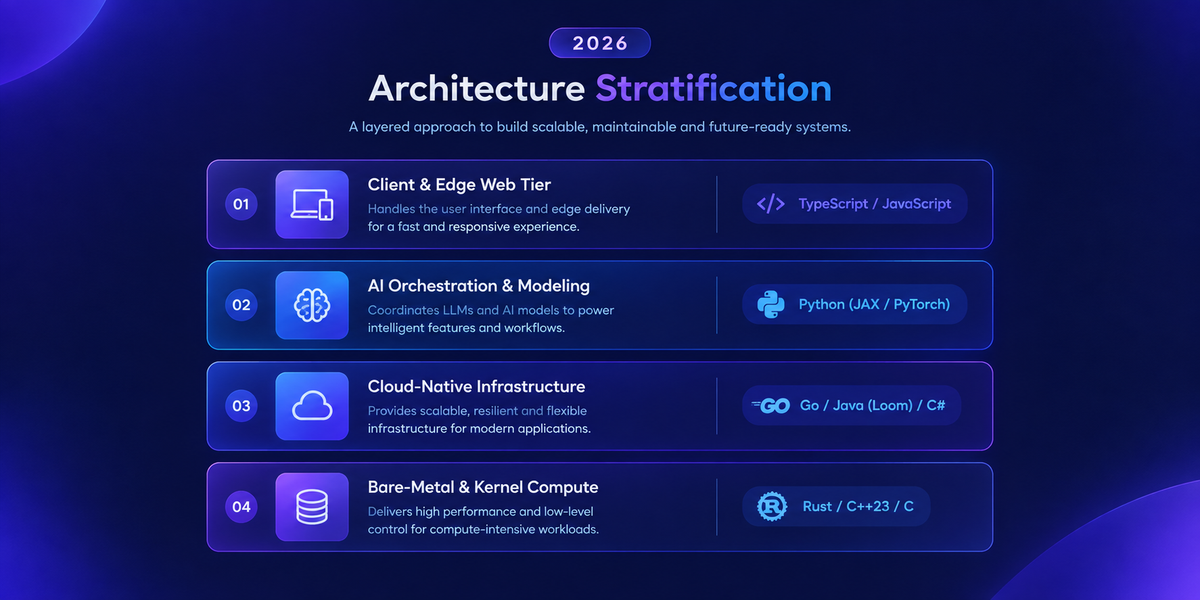
- AI & Machine Learning Infrastructure: Prioritize Python for model orchestration and Rust / C++ for low-latency inference serving and GPU memory management.
- Cloud Infrastructure & Microservices: Choose Go for operational simplicity and container performance, or Java (Virtual Threads) for legacy enterprise modernization.
- Systems, Security & Embedded: Invest in Rust. International cybersecurity compliance frameworks increasingly require memory-safe languages for new systems code.
First Lesson
You are at the beginning of this curriculum.
Latest Tutorial
More chapters coming soon to this topic.

Leave a Reply
Share your insights, questions, or solutions with the developer community.
Discussion
0No comments yet
Be the first to share your thoughts, question a concept, or provide additional tips!