
AlexNet Explained: The CNN That Revolutionized Deep Learning in 2012
How AlexNet Transformed Image Classification with Deep Convolutional Neural Networks
AlexNet is a deep learning model that made a big impact in image recognition. It became famous for its ability to classify images accurately. It won the ImageNet Large Scale Visual Recognition Challenge (ILSVRC) 2012 with a top-5 error rate of 15.3% (beating the runner up which had a top5 error rate of 26.2%)
Most important features of the AlexNet are:
- Overfitting Prevention: Dropout (0.5) was applied to the first two fully connected layers and data augmentation dynamically expanded the dataset hence both helping in reducing overfitting.
- Faster Training: ReLU activation was used instead of tanh or sigmoid, leading to a 6x speedup in training by avoiding.
AlexNet Architecture
Its architecture includes:
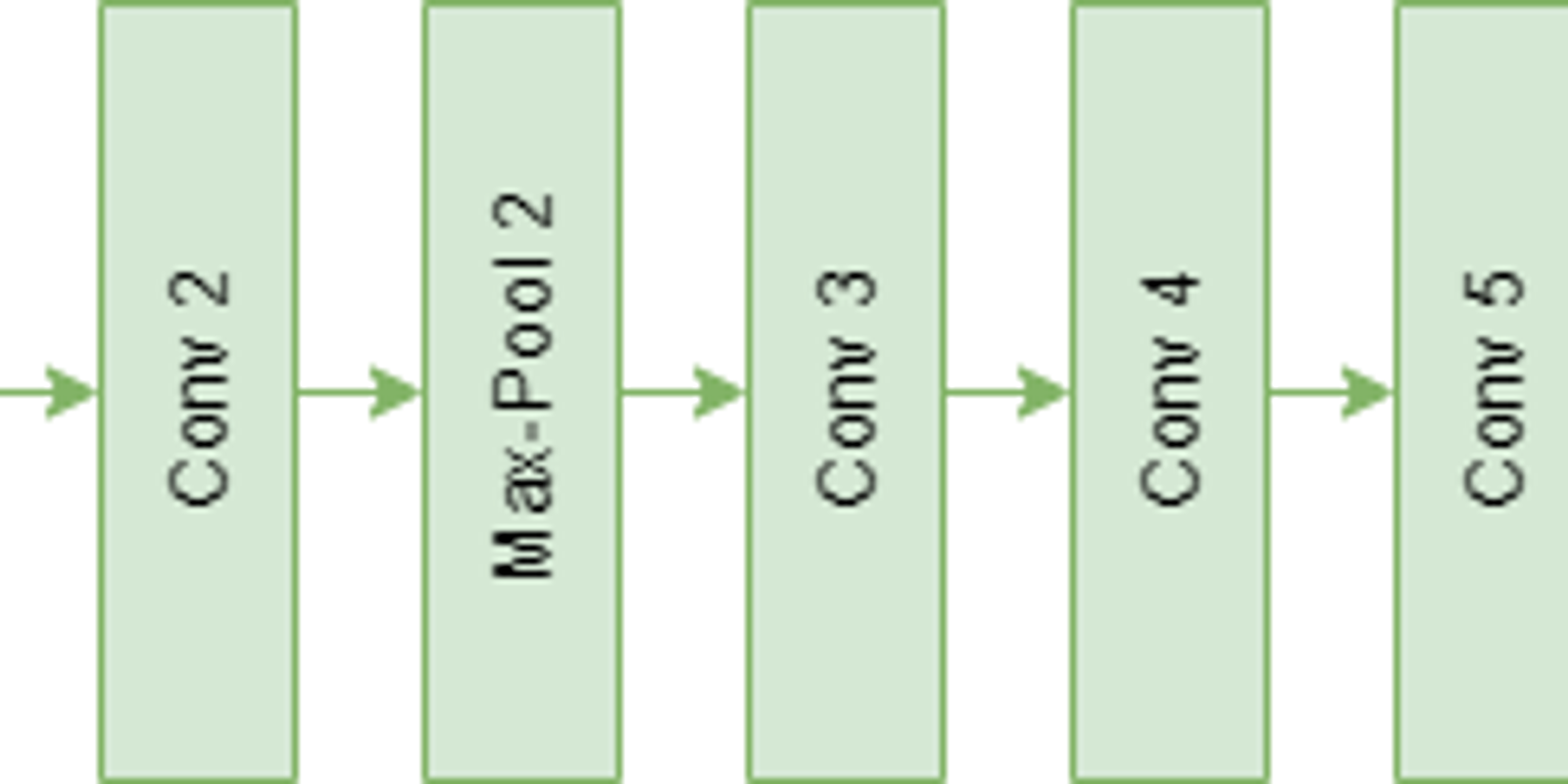
- 5 convolutional layers with Max-Pooling applied after the 1st, 2nd and 5th layers to enhance feature extraction.
- Overlapping Max-Pooling uses a 3×3 filter with stride 2 which improved performance by reducing top-1 error by 0.4% and top-5 error by 0.3% compared to non-overlapping pooling.
- Followed by 2 fully connected layers each using dropout to prevent overfitting.
- Ends with a softmax layer for final classification.

Implementation of AlexNet for Object Classification
Here we will see step by step implementation of alexnet model:
1. Import Libraries
We import tensorflow and matplotlib for it.
2. Load and Preprocess CIFAR-10 Dataset
- CIFAR-10 contains 60.000x32x32 RGB images across 10 classes.
- Pixel values are scaled to [0,1].
- Labels are one-hot encoded for softmax classification
3. Define the AlexNet Model (Adjusted for CIFAR-10)
- Adjusted to CIFAR-10's 32×32 input size and 10 output classes.
- Reduced FC layers from 4096→1024→512 to avoid overfitting on small images.
- Uses ReLU, Dropout, BatchNorm and softmax in the final layer.
4. Compile the Model
We use adam optimizer and categorical_crossentropy for multi-class classification.
5. Train the Model
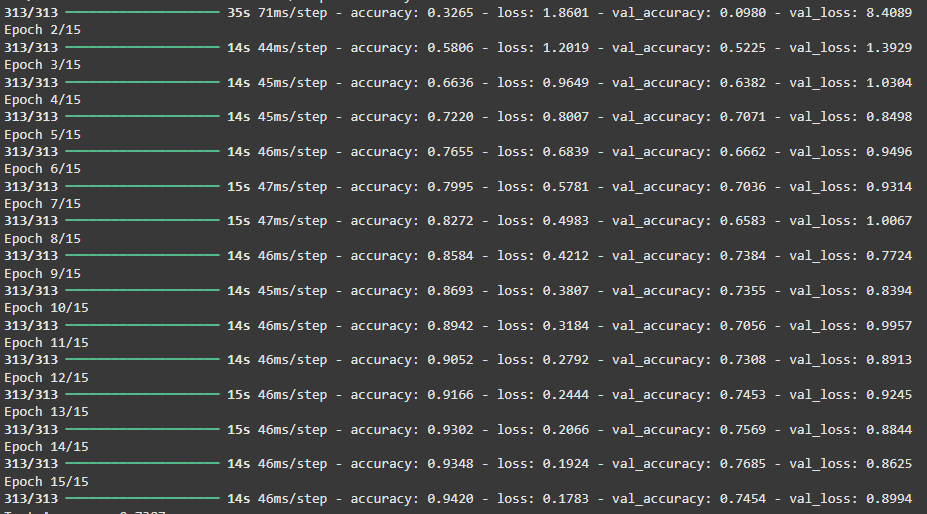
- Train for 15 epochs, with 20% validation split.
- You can increase epochs for better accuracy.
Output:
6. Evaluate the Model
7. Plot Training & Validation Accuracy
Output:
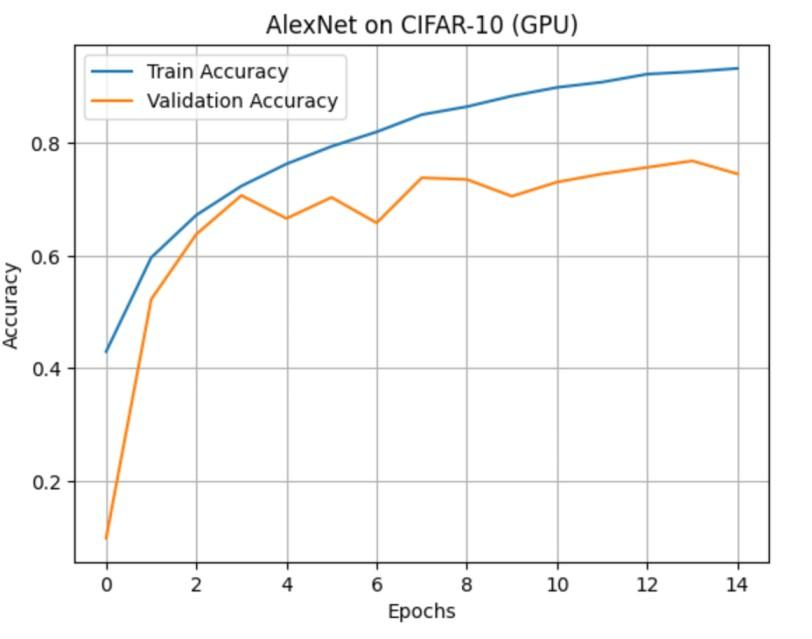
We can see that train and validation accuracy is quit similar in end meaning our model is working fine.
Advantages of AlexNet
- Use of ReLU Activation: First major architecture to use ReLU (Rectified Linear Unit) which enabled faster training compared to traditional tanh/sigmoid functions.
- Dropout for Regularization: Introduced dropout layers to reduce overfitting by randomly disabling neurons during training.
- GPU Utilization: Split the network across two GPUs, showing how deep learning can benefit from parallel computing for faster training.
- Overlapping Max-Pooling: Used overlapping pooling layers to improve generalization and reduce top-1 and top-5 classification errors.
Disadvantages of AlexNet
- Large Model Size: Has around 60 million parameters making it memory-intensive and slow for inference on low-resource devices.
- High Computational Cost: Training is computationally expensive even though it was optimized for GPUs.
- Manual Architecture Design: The architecture lacks modularity and automation, unlike modern approaches like NAS or EfficientNet.
- Not Optimal for Small Datasets: Tends to overfit on smaller datasets like CIFAR-10 or MNIST without heavy regularization.
- Outdated Compared to Modern Architectures: Lacks innovations like residual connections (ResNet), depthwise separable convolutions (MobileNet) and attention mechanisms (ViT).
Applications
- Image Classification: Originally built for classifying high-resolution images into 1000 object categories (ImageNet dataset).
- Feature Extraction: Intermediate layers are often used as pretrained feature extractors for transfer learning tasks.
- Object Detection: Forms the backbone in early detection systems like R-CNN when combined with region proposal methods.
- Medical Imaging: Applied to classify abnormalities in X-rays, MRIs or retinal scans by fine-tuning on domain-specific datasets.
- Facial Recognition and Emotion Detection: Can be adapted for face verification, expression analysis or identity recognition tasks.
- Autonomous Vehicles: Used in early perception modules for identifying road signs, pedestrians or obstacles.



Leave a Reply
Share your insights, questions, or solutions with the developer community.
Discussion
0No comments yet
Be the first to share your thoughts, question a concept, or provide additional tips!